2:35 - 3:00 PM - Withstand Tests – More than meets
the eye, Joshua Perkel1
(Presenter) ,Nigel Hampton1, JC
Hernandez2, Miroslav Begovic2,
John Hans3, Ron Riley3,
Pete Tyschenko3, Frank Doherty4,
George Murray4, and Leeman Hong4
- 1NEETRAC, Georgia Institute of
Technology 2Department of
Electrical and Computing Engineering, Georgia Institute of Technology
3Commonwealth Edison,
4Consolidated Edison
Abstract: High voltage withstand tests are employed by a
large number of North American utilities as part of their reliability
programs. In fact, according to a study conducted in 2006 by NEETRAC for
the Cable Diagnostic Focused Initiative (CDFI), approximately 33% of the
member utilities routinely employing diagnostic tests use some form of
withstand. Previous work reported to ICC has described the benefits of
withstand tests in terms of future freedom from failures and the added
information content when the hold portion of the withstand test is
monitored in some convenient way. It is, therefore, worthwhile examining
the diagnostic understanding that can become available from the use of
elevated voltage on cable systems, or simple Hipots. Traditionally,
withstand tests have been thought of as purely the survival through the
“hold” portion (Figure 1) where the Passes greatly outnumber the Fails
(Figure 2). However, many utilities employing withstand tests typically
record a wealth of additional information during each test that can
include segment information (length), voltage, leakage current, and,
most importantly, when the cable system failed (Vf or tf – Figure 1).
This presentation starts with these data (field data obtained from
several large US utilities) and explores some of the useful diagnostic
outcomes that can be derived.
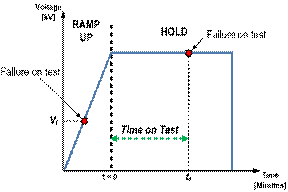
Figure 1: Withstand test “ramp up” and “hold” phases.
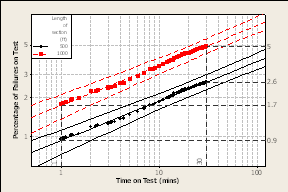
Figure 2: Failure on test rates for different segment
length, for the 30 minute test recommended by IEEE400.2.
The issues that can be quantitatively examined include:
• Test time (Figure 2)
• Test voltage • Likely outcomes for different sizes of cable system
(Figure 2)
• The importance of the voltage ramp (Figure 3)
• Prioritization of different parts of the cable system for future test
/ actions (Figure 4)
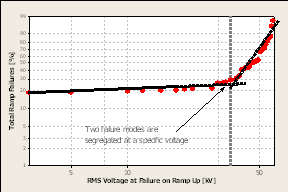
Figure 3: Weibull curves showing two modes of failure
during “ramp up” phase.
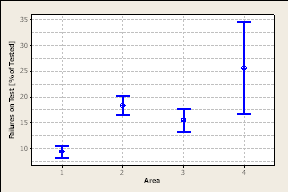
Figure 4: Separation of failure on test rates by areas.
The presentation will conclude with some suggestions as to the operating
and recording protocols that will maximize the diagnostic capability of
withstand tests.